
Engineering12 September 2026
Your Next.js site is fast on your laptop and slow on your customer's phone
Most Bangladeshi traffic arrives on a mid-range Android over a congested network. Here is what that actually changes about how you build.
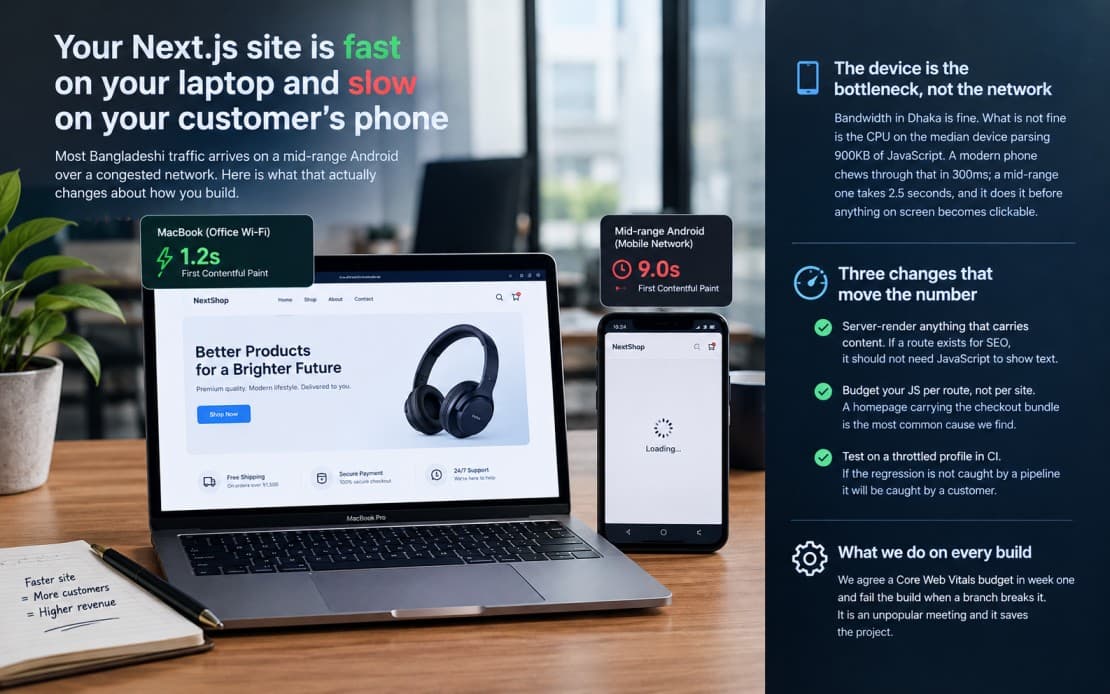
Every performance conversation we have starts the same way: someone opens the site on a MacBook over office fibre, sees it paint instantly, and concludes there is no problem. Then we open it on a three-year-old Android on a shared mobile connection and the same page takes nine seconds.
The device is the bottleneck, not the network
Bandwidth in Dhaka is fine. What is not fine is the CPU on the median device parsing 900KB of JavaScript. A modern phone chews through that in 300ms; a mid-range one takes 2.5 seconds, and it does it before anything on screen becomes clickable.
Three changes that move the number
- Server-render anything that carries content. If a route exists for SEO, it should not need JavaScript to show text.
- Budget your JS per route, not per site. A homepage carrying the checkout bundle is the most common cause we find.
- Test on a throttled profile in CI. If the regression is not caught by a pipeline it will be caught by a customer.
What we do on every build
We agree a Core Web Vitals budget in week one and fail the build when a branch breaks it. It is an unpopular meeting and it saves the project.
Filed under
- Performance
- Next.js
- Core Web Vitals
- Mobile
Read next
All articlesVisualization
A 3D render is a sales document, not an artwork
Buyers read a floor plan in about four seconds. Everything in the render should be serving that four seconds.
12 Sept 2026
Growth
Stop measuring impressions. Measure cost per qualified lead.
If your reporting dashboard cannot answer what a closed deal cost to acquire, it is a screensaver.
12 Sept 2026
Production
What 11,400 product images taught us about QC
At catalogue scale, the difference between a 1% and a 6% rejection rate is not skill. It is whether feedback is written down.
12 Sept 2026
Next step
Recognise the problem in this one?
Most of these started as an audit finding on someone else's system. If it sounds like yours, that is usually the cheapest place to start.
or email info@strsltd.com. We reply to every inquiry within one business day.